

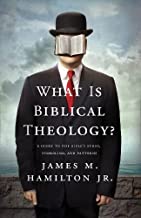
James M. Hamilton Jr. is a Professor of Biblical Theology at Southern Baptist Theological Seminary and the pastor of Kenwood Baptist Church. He is the author of several books and scholarly articles on biblical theology, and his work has been highly praised by other scholars in his field. In his book, What is Biblical Theology? A Guide to the Bible’s Story, Symbolism, and Patterns, Hamilton introduces the reader to biblical theology by bringing the whole narrative of Scripture together and explaining its patterns and symbolism. While the book is intended for readers who are not familiar with biblical theology, those who are will find much value in this book.
Summary
Hamilton begins his book with two brief chapters, then divides the book into three parts, followed by a brief epilogue. In chapters one and two, he introduces the topic of biblical theology and explains its aims and purposes. Hamilton defines biblical theology as “the interpretive perspective of the biblical authors” (15), by which he means, “the framework of assumptions and presuppositions, associations, and identifications, truths, and symbols that are taken for granted as an author or speaker describes the world and the events that take place in it” (15). The main thesis of his book is to show that the “biblical authors operated from a shared interpretive perspective” (20). To prove this, Hamilton will show that the Bible has a unifying metanarrative that the biblical authors interpret through a set of key symbols they share in order to teach the Church how it fits into this grand scheme. This corresponds to the three parts of his book.
In the first part, Hamilton lays out the metanarrative of Scripture and examines its plot and patterns. To Hamilton, the Bible’s storyline is analogous to a drama in which God is the playwright and the universe is the theatre. There is a setting, characters, and a plot that communicate themes throughout Scripture. According to Hamilton, God created the universe as a “place where he is known, served, worshiped, and present” (27) – a cosmic temple – that is the setting for the Bible’s storyline. Hamilton summarizes the plot of Scripture in terms of redemptive history: creation, fall, redemption, and restoration. This mystery progressively unfolds through the repetitious use of symbols that form patterns throughout Scripture.
In the second part of the book, Hamilton explains the Bible’s symbolism and how the symbols, types, and patterns interpret the storyline of Scripture. His main focus in this part is on how the symbols are used by the biblical authors. Hamilton believes that the symbols are used by the biblical authors to interpret the Bible and summarize its storyline. The patterns that these symbols and images form foreshadow people, events, and institutions through the Bible’s typology. For Hamilton, types are more than mere literary devices; they are real people, events, and institutions. He says that a biblical type has actual historical correspondence and escalation from the initial instance to its ultimate fulfillment. Hamilton includes several examples from Scripture of how this apparently works and concludes the section by showing that the symbols teach us that “Jesus is our paradigm, our pattern, our example” (90).
In the third part, Hamilton examines how the metanarrative and symbolism of Scripture help us think about the Church’s place in the story. He briefly surveys the metaphors that Scripture uses to typify the Church, showing that the Church is like a sheep with a shepherd, a bride with her husband, a body with a head, a child that was adopted, and the temple of God. This last metaphor is especially important, as it reveals that the temple of God – a symbolic microcosm – typifies the church, which is itself the temple of the Spirit. Thus, the Church “is to be a preview of what the world is going to become” (106). Hamilton concludes this part by acknowledging the tension between this vision of the Church and the life of the believer.
The epilogue encourages the reader to continue to study biblical theology. Hamilton provides advice for reading Scripture and directs the reader to further sources of study, including his book, God’s Glory in Salvation through Judgement: A Biblical Theology.
Critical Evaluation
There is much to be appreciated in What Is Biblical Theology? A Guide to the Bible’s Story, Symbolism, and Patterns. Hamilton has written an excellent introduction to biblical theology that introduces his reader to his own unique perspective. This review will highlight three positive aspects of the book, which include its experiential emphasis, exegetical insights, and expositional brevity. There shall also be provided a short critique of the book’s weaknesses.
Throughout the text, the reader will notice a strong experiential emphasis that both challenges and encourages the reader to reflect on their standing with God. For instance, after discussing the role of the characters of the Bible’s story, Hamilton asks the reader, “What part do you play in this drama? Have you embraced the role you were made to enact, or are you trying to be God?” (31). Such questions test the reader’s standing before God which drives them to deeper reflection of their life in Christ. This reviewer found himself reflecting on these experiential nuggets as he was reading the book and was challenged to examine his own walk with Christ. The reader will not find a dry, academic tone in Hamilton’s writing, but rather a deep well that is nourishing to the soul.
Another positive aspect of the book is the exegetical insights gleaned from Hamilton’s unique perspective of biblical theology, which consists of two key concepts: (1) that the Bible’s central theme is the glory of God in salvation through judgment, an idea that he develops fully in his book, God’s Glory In Salvation Through Judgement: A Biblical Theology; and (2) promise-shaped typology, which forms the thesis of his book Typology: Understanding The Bible’s Promise-Shaped Patterns. These two concepts form Hamilton’s system of biblical theology that he summarizes in What Is Biblical Theology? A Guide to the Bible’s Story. Therefore, the book is an introduction to his specific system of biblical theology but provides a bridge for beginners to enter into the broader project of his other books.
One main aspect of Hamilton’s argument is that Scripture should be interpreted by using the methods of the biblical authors, which includes the use of types, symbols, and patterns throughout Scripture. The reader may object, however, that we have no certainty in what these things mean and are, therefore, unable to interpret the Bible like the biblical authors. Hamilton justifies his view by arguing that if the Holy Spirit inspired the biblical authors, then their perspective is divinely inspired (21). Furthermore, they were taught to interpret the Bible using types, symbols, and patterns by Jesus Christ, whom Hamilton claims, “learned the interpretive perspective he taught to his disciples from Moses and the Prophets” (20). Therefore, one ought to follow the apostles as they followed Christ in interpreting the Bible through their “shared interpretive perspective” (20). Hamilton is correct in his assertion, and such a view directly follows from the Reformation doctrine of Sola Scriptura. If Scripture is sufficient and the sole authority in all matters of faith and practice, then surely, we are taught by Scripture through the same Holy Spirit who inspired it how to read and understand it.
Hamilton is a master of typological hermeneutics and his views in this book have profoundly impacted the way this reviewer thinks of biblical typology. Hamilton convincingly states that “the biblical authors model a perspective for interpreting the Bible, history, and current events” (21), and his assertion that they shared this perspective and learned it from previous biblical authors is interesting and innovative. Thus, according to Hamilton, Moses built patterns and types using a set of symbols, what Hamilton calls a “symbolic universe” (64), subsequent Old Testament authors picked up on this scheme and propagated it, then the New Testament authors continued this tradition by incorporating the symbolic universe into their own writings (20-21). The symbolic universe is the key to understanding their shared worldview, and to understand Scripture, it is necessary to understand what these symbols communicate. As Hamilton says, “the images the Bible uses are meant to give real-world illustrations of these abstract concepts…[the biblical authors are] trying to help their audience understand by using examples” (67). Hamilton’s argument is persuasive, and further development of this idea would prove to be fruitful.
The final positive aspect to comment on is the expositional brevity with which Hamilton writes. The book is only 128 pages, but Hamilton is able to pack a significant amount of information into a small space in a way that is intelligible to the average reader. He includes many examples and stories to illustrate his points. The text is well organized, so the reader is not lost in a jungle of words. At times the book is too brief, and he leaves some loose ends untied. For instance, the topic of chapter ten is the bride of Christ, and Hamilton makes the connection between Ezekiel 16 and Revelation 12 to show that these events symbolize Israel and the Church. However, he never elaborates in this chapter as to how these events relate to the bride of Christ but only briefly develops this theme in the next chapter. It would have been more helpful to have included more examples and illustrations from Scripture to show his point in this chapter.
Conclusion
Hamilton’s book, What Is Biblical Theology? A Guide to the Bible’s Story, Symbolism, and Patterns is an excellent introduction to the discipline of biblical theology and provides an avenue for readers to acquaint themselves with Hamilton’s perspective before moving on to his other literature, especially God’s Glory In Salvation Through Judgement and Typology: Understanding The Bible’s Promise-Shaped Patterns. This book is excellent for readers who may have read the Bible but are unaware of the interconnectedness between the symbols and patterns. The book is relatively brief, packed with numerous exegetical insights and examples, and will challenge the reader to reflect on their own standing with God as they examine the role and purpose of the Bible’s story, symbolism, and patterns.

 The Southern Pulpit